Showing posts with label Koichi Tohei. Show all posts

Friday, November 8, 2024

Internal power and yoga?

 I said I wouldn’t comment on hatha yoga due to a lack of knowledge and/or familiarity. Out of curiosity, I have taken a few trial lessons because I do wonder what the link is or could be with the things I do. Because, I think, there must be a common origin or a cross-pollination on fundamental points somewhere. Yoga as it is now known in the West comes from the Indian tradition. But certain forms of yoga are also known in China and Japan and they certainly seem to have left their mark on these things that I try to learn and do.

For example, there is the so-called Japanese yoga or also called Shinshin-tōitsu-dō by Tempu Nakamura. The aikido style in which I train can be traced back in a direct line to Koichi Tohei and his influence is still very obvious there. And he gave his aikido style, usually called ki-aikido, the name Shin Shin Toitsu Aikido in imitation of the Shinshin-tōitsu-dō of his teacher and inspirer Nakamura. That name stands for the coordination of body and mind and on the basis of the ideas of this Japanese yoga, Tohei formulated the four principles for the coordination of body and mind, namely:

Keep one point - Maintaining the core

Relax completely - Complete relaxation

Keep weight underside - Have a light feeling (variation)

Extend Ki - Attention is directed outwards

Principles that bring about peace and stability and can be applied everywhere in daily life. One cannot exist without the other and they reinforce and sustain each other.

In a famous interview (part1 and part2), Tohei said that all he learned from Morihei Ueshiba (the founder of aikido) the importance of being relaxed, but from Nakamura that which was the key to getting into that state. So what I am doing on the tatami may still have something to do with yoga, albeit one of a specific kind that is more like a form of dynamic meditation than adopting certain body poses.

Now, this Japanese yoga (as well as aikido) is of fairly recent origin. This is in contrast to Chinese or Daoist yoga. This image from the so-called Mawangdui Silk Texts dates from the second century BC.

But what Chinese or Daoist yoga is or what that looks like is not so easy to figure out. When I search for Yoga in one of the search engines, it yields not only information about yoga, but also a lot of sites and addresses where I could learn yoga, often with images of well-proportioned and flexible women in trendy and fashionable outfits. In short, much in the style of the magazine Happinez; all very nice but not the first source I would like to get my information from. When I search for Chinese or Daoist yoga, it doesn't seem very different, although additional terms like qigong, daoyin, do-in and yin yoga seem to surface all around. Snooping around like this, it seems to me that a lot of hybrid forms have emerged. And when I ask myself how often and since when I hear the term Yin yoga, I would guess it is mainly something from the last decade. Now there is nothing against new forms, they are inevitable, but in that multiplicity and hodgepodge it may become a bit difficult to distinguish some quality.     

In order to ascertain myself of some standard of quality and thoroughness on these seemingly thoroughly windswept and tangled grounds, I’d rather rely on someone like Bruce Frantzis than on sources such as Happinez magazine. In his Daoist or Longevity Breathing Yoga program, Bruce Frantzis publishes a pdf entitled: Longevity Breathing Yoga - Meditation from the Inside Out. In it he draws a comparison between Daoist and Hatha Yoga. In that context, four clear quotes from the aforementioned and highly recommended publication:

Chinese and Indian traditions share a common goal: To calm the internal noise of the monkey mind—swinging from tree to tree—and connect with the chi that penetrates and interconnects all and everything.

Longevity Breathing yoga and Hatha yoga can help lead you to experience the final goal of not only quieting the monkey mind, but also experiencing enlightenment.

At the initial levels of practice, Longevity Breathing yoga and Hatha yoga practices differ; at the higher levels, on the path towards enlightenment, the practices converge

The purpose of both Taoist and Hatha yoga breathing exercises is to take you to a place where you can contact the energy of your body and spirit purely with your mind, regardless of the kind of breathing exercise you do. The way they are taught, however, differs in the Chinese and Indian traditions.

Furthermore, I remember that I once heard Bruce say in a video that in hatha yoga one tries to relax in the lenghtening or the stretch, while the Daoists want to bring about the stretch or lenghtening more or less by itself throughrelaxing. This also touches on the distinction between the fire and water methods, which is essential to the Energy Arts program as thaught by Frantzis.

From the above quotes, we may conclude that at its core it is about something else or something more than cultivating flexibility, fitness, strength or stamina. That more must then be sought in the connection or unity of body and mind.

Yoga is the Sanskrit word for "yoke" or unity or connection, and in the various treatises on yoga the unification or balancing of the physical, the mental and the spiritual in man is usually mentioned as the ultimate goal.

Also in my aikido training I am regularly reminded that I should try to achieve that unity of body and mind. (see Tohei’s principles above)

But wait a minute ....... Would that imply I have been trying, without even being aware of it, to practice yoga for so many years now?

<<< previous - next >>>

Internal power en yoga?

 Over hatha yoga zou ik me wegens een gebrek aan kennis en/of bekendheid dus niet uitlaten. Ik heb uit nieuwsgierigheid overigens wel eens een paar proeflessen gevolgd omdat ik me toch afvraag wat de link is of kan zijn met de dingen die ik doe. Want ergens zou er, meen ik, toch een gezamenlijke oorsprong dan wel een kruisbestuiving op fundamentele punten moeten zijn te vinden. Yoga zoals dat nu in het Westen bekend is komt uit de Indiase traditie. Maar bepaalde vormen van yoga zijn ook in China en Japan bekend en die laten ontegenzeggelijk hun sporen na in hetgeen ik probeer te doen of te leren.

Zo is daar bijvoorbeeld de zogeheten Japanse yoga of ook wel Shinshin-tōitsu-dō van Tempu Nakamura. De aikido stijl waarin ik train is in een directe lijn terug te leiden tot Koichi Tohei en zijn invloed is daar ook overduidelijk. En zijn aikido stijl, doorgaans ki-aikido genoemd, gaf hij de naam Shin Shin Toitsu Aikido in navolging van het Shinshin-tōitsu-dō van zijn leraar en inspirator Nakamura. Die naam staat voor de coördinatie van lichaam en geest en op grond van het gedachtegoed van deze Japanse yoga formuleerde Tohei de vier principes voor de coördinatie van lichaam en geest, te weten:

Handhaving van de kern - Keep one point
Volledige ontspanning - Relax completely
Gewicht aan de onderkant - Keep weight underside / Have a light feeling (variation)
Aandacht is naar buiten gericht - Extend Ki


Principes die rust en stabiliteit teweegbrengen en overal in het dagelijks leven toegepast kunnen worden. Ze een kan niet zonder de ander en ze versterken elkaar en houden elkaar in stand.


In een fameus interview (deel1 en deel2) zei Tohei dat hij van Morihei Ueshiba (de stichter van het aikido) het belang van ontspannen zijn leerde maar van Nakamura wat de sleutel was om in die staat te komen. Zo heeft hetgeen ik doe misschien toch nog iets met yoga van doen, zij het een van een specifieke soort die meer weg heeft van een vorm van dynamische meditatie dan van het aannemen van bepaalde lichaamsposes.

Nu is deze Japanse yoga (evenals het aikido) van vrij recente oorsprong. Dit in tegenstelling tot de Chinese of Daoïstische yoga. Deze afbeelding uit de zogeheten Mawangdui Silk Texts dateert uit de tweede eeuw voor Christus.


Maar wat dan Chinese of Daoïstische yoga is of hoe dat er uit ziet is nog niet zo makkelijk te achterhalen. Wanneer ik op Yoga zoek in een van de zoekmachines levert dat behalve informatie over yoga vooral erg veel sites en adressen waar ik yoga zou kunnen leren op, veelal voorzien van afbeeldingen van goed geproportioneerde en lenige vrouwen in trendy en modieuze outfit. Kortom veel in de stijl van het magazine Happinez; leuk maar toch niet de eerste bron waar ik mijn informatie vandaan zou willen halen. Wanneer ik op Chinese of Daoïstische yoga zoek lijkt dat niet erg veel anders zij het dat dan termen als qigong, daoyin, do-in en yin yoga de overhand lijken te krijgen. Zo rondneuzend komt het me voor dat er vooral veel hybride vormen zijn ontstaan. En als ik me dan eens afvraag hoe vaak en sinds wanneer ik de term Yin-yoga voorbij hoor komen denk ik dat dat vooral iets van het laatste decennium is. Nu is er niets tegen nieuwe vormen, die zijn onvermijdelijk, maar in die veelheid en die mengelmoes wordt het misschien toch wat moeilijk om kwaliteit te onderscheiden.

Om zoveel mogelijk van kwaliteit en gedegenheid verzekerd te zijn op dit op het oog toch wat verwaaide en verwarde terrein ga ik toch liever af op iemand als Bruce Frantzis dan op bronnen a là Happinez magazine. In zijn Daoïst of Longevity Breathing Yoga programma geeft Bruce Frantzis een publicatie uit onder de titel: Longevity Breathing Yoga - Meditation from the Inside Out. Hierin trekt hij ondermeer de vergelijking tussen de Daoïstische en de Hatha Yoga. In dat verband vier heldere citaten uit voornoemde en zeer aan te raden publicatie:

Chinese and Indian traditions share a common goal: To calm the internal noise of the monkey mind—swinging from tree to tree—and connect with the chi that penetrates and interconnects all and everything.

Longevity Breathing yoga and Hatha yoga can help lead you to experience the final goal of not only quieting the monkey mind, but also experiencing enlightenment.

At the initial levels of practice, Longevity Breathing yoga and Hatha yoga practices differ; at the higher levels, on the path towards enlightenment, the practices converge

The purpose of both Taoist and Hatha yoga breathing exercises is to take you to a place where you can contact the energy of your body and spirit purely with your mind, regardless
of the kind of breathing exercise you do. The way they are taught, however, differs in the Chinese and Indian traditions.

Verder herinner ik me dat ik Bruce ooit in een video hoorde zeggen dat men in hatha yoga probeert te ontspannen in de verlenging of de stretch terwijl de daoïsten de stretch of verlenging min of meer automatisch teweeg willen brengen door te ontspannen. Dat raakt dan tevens aan het voor Frantzis essentiele onderscheid tussen de vuur- en de water-methode.

Uit bovenvermelde citaten mogen we opmaken dat het in de kern om iets anders of iets meer gaat dan het cultiveren van lenigheid, fitness, kracht of conditie. Dat meer moet dan gezocht worden in de verbinding tussen of de eenheid van lichaam en geest.
Yoga is het Sanskriet woord voor "juk" of eenheid of verbinding en in de diverse verhandelingen over yoga wordt ook meestal het tot eenheid of in balans brengen van het lichamelijke, het mentale en het spirituele in de mens als ultiem doel genoemd.
Ook in mijn aikido-training wordt ik er met regelmaat op gewezen dat ik die eenheid van lichaam en geest moet trachten te bewerkstelligen. (zie de principes van Tohei hierboven)


Maar wacht eens even …… zou ik dan al die jaren geprobeerd hebben, zonder me daar bewust van te zijn, om yoga te beoefenen?

<<< vorige - volgende >

Sunday, October 27, 2024

Interne kracht en qi

 Hoe stuit een mens op een onderwerp als dit en waarom zou het iemand überhaupt boeien? Wel je hoort of je leest zo eens wat en zoals ik eerder vertelde was ik op een maandagavond in 1981 zomaar lid van een dojo en begon ik aan een aikido-training. Daar kwam met regelmaat het begrip "ki" ter sprake niet alleen omdat het nu eenmaal de middelste lettergreep van de naam aikido is maar omdat het een belangrijk en centraal begrip in de filosofie van het aikido is. Energie of een alles doordringende levensenergie zou de globale uitleg en de meest passende vertaling hiervan zijn. Dat was natuurlijk allemaal mooi en aardig maar vooralsnog was het in wezen natuurlijk niet meer dan een idee in mijn hoofd en dan vooral een wel erg magisch aandoend idee.

In het wereldbeeld waarbinnen het aikido kon ontstaan wordt "ki" gezien als de life-giving force of de basale trilling die ten grondslag ligt aan het leven. Het is net als licht of geluid een vibratie en een die heel fundamenteel is voor het leven en alle leven doordrenkt. Iets in dergelijke bewoordingen en van vergelijkbare strekking valt ook in de vele boeken over aikido en aanverwante perspectieven te lezen. Voor de meeste van ons toch nog steeds een erg vaag idee, zou ik zo denken.
Nu is ook niet elke aikidoka in dezelfde mate bezig met of zelfs maar overtuigd van het bestaan van "ki". Iemand als Christian Tissier zul je er zelden over horen en iemand als Nick Lowry meent dat de effecten die aan ki toegeschreven worden zich eenvoudig wetenschappelijk laten verklaren als natuurkundige en biologische verschijnselen.

Koichi Tohei, de ooit gedoodverfde opvolger van de stichter van het aikido, maakte er echter een centraal thema van in zijn benadering. Tohei's stijl van aikido staat dan ook wel bekend als Ki-aikido. Daarnaast richtte hij de Ki-society op speciaal met het doel om mensen te leren hoe middels oefeningen ki te cultiveren. In Tohei's boek Book of Ki: Co-ordinating Mind and Body in Daily Life heeft hij het op bladzij 34-36 over positieve geestkracht. Je geest positief aanwenden is voor hem hetzelfde als het uitsturen van ki. Drie foto's illustreren een test waarbij de proefpersoon bij hoofd/schouders en hielen van de grond wordt getild. Op de eerste foto zie je de proefpersoon een beetje levenloos doorzakken. Op de volgende foto zie hoe de persoon door zich van top tot teen als een massief en onbuigzaam geheel voor te stellen, ofwel het lichaam met ki te vullen, zich zonder door te buigen mooi en recht als een plank laat optillen. Op de derde foto is hij als een plank tussen en op twee stoelen gelegd zitten er drie personen met hun volle gewicht leunend op zijn romp en benen.

Dit zal menigeen wellicht als moeilijk voorstelbaar voorkomen maar het toeval wil dat ik ruim 40 jaar geleden hier een overtuigende demonstratie van mocht bijwonen. De drie, hier genoemde , bruine banden speelden en experimenteerden met dit verschijnsel en met succes. Met name Frans lukte het erg goed en hij kon in ontspannen toestand ook nog het nodige gewicht dragen zij het geen drie personen. Ik kon die truc overigens zelf niet herhalen en dat lukt mij nog steeds niet. Hoe dan ook intrigeerde het mij en maakte de nodige indruk. Inmiddels begrijp ik dat dit net zoiets is als de onbuigzame arm waar in aikido veel over hoort. Bij dit alles zou ki of chi, of hoe je het ook noemen wilt, dus een sleutelrol spelen. Wat is dat dan die ki?

Nu kan iedereen je van alles en nog wat vertellen over wat en hoe je iets moet doen maar als je daar niet iets herkenbaars en/of reproduceerbaars bij voelt en je ziet geen resultaat van hetgeen je probeert te doen, dan schiet je daar natuurlijk niets mee op. Dus luidt de vraag of je ook iets van die energie kunt voelen? Nu begint het om een aantal redenen vrij ingewikkeld te worden maar je kunt er inderdaad wel iets van voelen. Naar ik heb horen vertellen is het onder Aziatische kinderen geen ongebruikelijk spelletje om de handen gespiegeld tegenover elkaar te houden om daar tussen iets te voelen. De handen en met name de plek die de Chinezen lao-gong noemen zijn bij uitstek geschikt om chi te (leren) voelen. Beoefenaars van Qigong zullen dit verschijnsel wel kennen van het spelen met de bal. Nu is het één ding om middels een tintelend gevoel iets van die energie gewaar te worden maar om die energie vervolgens nuttig of ten goede aan te kunnen wenden is toch nog iets heel anders en vraagt wel iets meer.


Wat betreft dat aanwenden van qi leerde ik van Bruce Frantzis dat je het globaal gesproken kunt gebruiken om te vechten, om te helen of om te mediteren. Drie vormen of toepassingen die steeds een stapje verder gaan. (zie hier een interview met hem)

Wanneer je die energie, of de werking of doorstroming ervan, daadwerkelijk kunt voelen dan zou je wellicht kunnen denken dus des te meer ik voel des te beter. Maar hier schuilt een addertje onder het gras. Want als wij iets in het lichaam voelen betreft dat niet zelden opwinding en/of spierspanning. En nu is het zo dat het aanspannen van de spieren juist de doorstroming verhindert van die energie waar we het hier over hebben. Daarom hoor je in de internal martial arts voortdurend dat je moet 'ontspannen'. In the Chinese tradities heet het dat je 'song' of 'sung' moet zijn om de 'qi' te laten stromen.

Wanneer we het over 'qi' of 'chi' hebben, moet toch ook de beoefening van qigong of chi kung vermeld worden. Zoals in de naam vervat richt deze discipline zich op specifiek op het cultiveren van chi. Er lijkt een groeiende belangstelling te zijn voor de beoefening van qigong. Er bestaan heel veel vormen van qigong (zelfs een waarbij je alleen maar staat) die ook om veel verschillende redenen worden beoefend zoals uit onderstaand citaat mag blijken:

Today, millions of people worldwide practice qigong. Similar to its historical origin, those interested in qigong come from diverse backgrounds and practice it for diverse reasons, including for exercise, recreation, preventative medicine, self-healing, self-cultivation, meditation, and martial arts training. This was highlighted in the 1998 documentary titled, "Qigong - Ancient Chinese Healing for the 21st Century" by Francesco Garri Garripoli which aired on PBS-TV seen by over 88 million Nielsen-certified viewers.

De naam qigong is overigens pas sinds halverwege de vorige eeuw in zwang. Daarvoor sprak men over neigong dat zoiets betekent als intern werk. Een bijzondere qi- en neigong die mijn speciale interesse heeft is Yan Shou Gong.

In het scala van disciplines of oefenvormen waarin het samenvloeien of samenwerken van lichaam en geest centraal staan is Yoga veruit de bekendste en de meest beoefende. Vanuit de Indiase traditie kennen we ook het begrip prana als het schijnbare equivalent van chi of ki. Nu meen ik mensen die yoga beoefenen toch zelden te horen over het cultiveren van prana. Maar ik te weinig van deze (hatha)yoga om daar iets innigs over te kunnen zeggen en daar zal ik dus ook niet aan wagen.

<< vorige - volgende>>

Internal power and qi

 How does one ever stumble upon a subject like this and why should it be of any interest? Well, sometimes you just hear or you read about something or other and as I told you before, on a Monday evening in 1981 I all of a sudden became a member of a dojo and I started an aikido training. The term "ki" was regularly discussed, not only because it is the middle syllable of the name aikido, but because it is an important and central concept in the philosophy of aikido. Energy or an all-pervading life energy would be the general explanation and the most appropriate translation of this term. Now it was all nice and well to hear about this force, but for the time being it was essentially no more than an idea in my head and especially a very magical idea.

In the worldview in which aikido could originate, "ki" is seen as the life-giving force or the basic vibration that underlies life. It is a vibration just like light or sound and one that is very fundamental to life and permeates all life. Some similar explanation can befound in the many books on aikido and related arts and perspectives. For most of us, this will still be a rather vague idea, I would think.

Now, not every aikidoka is equally concerned with or even convinced of the existence of "ki". You will rarely hear Christian Tissier, for instance, talk about it and Nick Lowry believes that the effects attributed to ki can easily be explained scientifically as physical and biological phenomena.

However, Koichi Tohei, the once designate successor of the founder of aikido, made it a central theme of his teachings. Tohei's style of aikido is known as Ki-aikido. In addition, he founded the Ki-society specifically with the aim of teaching people how to cultivate ki through exercises. In Tohei's book Book of Ki: Co-ordinating Mind and Body in Daily Life, he talks about positive mind power on pages 34-36. To him, using your mind in a positive way is the same as extending ki. Three photographs illustrate a test in which the subject is lifted off the ground by the head/shoulders and heels. In the first picture you can see the test subject sagging a bit lifelessly. In the following photo you can see how the person can be lifted nicely and straight like a plank by imagining himself from head to toe as a solid and inflexible whole, or by filling the body with ki, without bending. In the third photo he is placed like a plank between and on two chairs there are three people with their full weight leaning on his torso and legs.

This may seem difficult to imagine to many, but it just so happened that over 40 years ago I attended a convincing demonstration of this. The three brown belts mentioned here played and experimented with this phenomenon and with success. Frans in particular did very well and he was also able to carry some weight in that relaxed state, although not three people. By the way, I couldn't repeat that trick myself and I still can't. Anyway, it intrigued me and made quite an impression. Now I understand that this is just like the unbendable arm that you may hear about in aikido. In all of this, ki or chi, or whatever you like to call it, seems play a key role. Then what is this ki?  

Now anyone can tell you a whole lot of stories about what and how to do it, but if you don't feel something distinguishable, recognizable and/or reproducible when doing so and you don't see the result of what you're trying to do, then of course it is not going to get you anywhere. So the question arises, can you feel any of that energy? Here it's starting to get quite complicated for a number of reasons, but you can feel some of it. From what I have been told, it is not an unusual game among Asian children to keep their hands facing and mirroring one another in order to feel something between them. The hands and especially the place that the Chinese call lao-gong are ideally suited to (learn to) feel chi. Qigong practitioners will be familiar with this phenomenon through playing with the ball. Now it is one thing to become aware of energy through a tingling feeling, but to be able to put that energy to good use is something completely different and requires something more.

As far as the use of qi is concerned, I learned from Bruce Frantzis that you can use it to fight, to heal or to meditate. Three forms or applications that each goes one step further. (here you can see an interview with him)

When you can actually feel that energy, or the effects or flow of it,  you might be tempted to think, so the more I feel the better. But there's a catch here. Because when we feel something in the body, it often concerns excitement and/or muscle tension. And it just so happens to be the case that the tightening of the muscles prevents the flow of that energy that we are talking about here. That's why you constantly hear in internal martial arts that you have to 'relax'. In the Chinese traditions, it is said that you have to be 'song' or 'sung' in order for the 'qi' to flow.

When talking  about 'qi' or 'chi', the practice of qigong or chi kung should, of course, be mentioned. As the name suggests, this discipline focuses specifically on the cultivation of chi. There seems to be a growing interest in the practice of qigong. There are many forms of qigong (even one that entails just standing) that are also practiced for many different reasons, as can be clear from the quote below:

Today, millions of people worldwide practice qigong. Similar to its historical origin, those interested in qigong come from diverse backgrounds and practice it for diverse reasons, including for exercise, recreation, preventative medicine, self-healing, self-cultivation, meditation, and martial arts training. This was highlighted in the 1998 documentary titled, "Qigong - Ancient Chinese Healing for the 21st Century" by Francesco Garri Garripoli which aired on PBS-TV seen by over 88 million Nielsen-certified viewers.

The name qigong has only been in vogue since the middle of the last century. Before that time, the equivalent term was usually neigong which means something like internal work. Personally I am very interested in a special and powerful qi- and neigong called Yan Shou Gong.

In the range of disciplines or forms of exercise in which the merging or cooperation of body and mind take central stage, Yoga is by far the best known and the most practiced. From the Indian tradition, we are also familiar with the concept of prana as the apparent equivalent of chi or ki. Now, I don't think I hear people who practice yoga often talk about cultivating prana. But I am by far not familiar enough with this (hatha)yoga to say anything sensible about it and so I will not attempt to do so. 


<< previous - next >>

Wednesday, November 25, 2015

Koichi Tohei - ki-aikido

Het moderne aikido kent, zoals gezegd, diverse stijlen, scholen en richtingen.
Ik zal ze hier niet proberen op te noemen maar geïnteresseerden kunnen natuurlijk altijd bij de firma Google te rade gaan .
In dat verband wil toch één persoon wel speciaal vermelden en dat is Koichi Tohei.
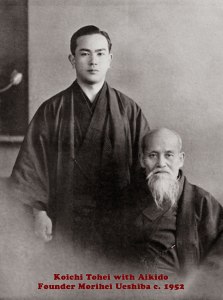
Samen met Kisshomaru Ueshiba kan Koichi Tohei beschouwd worden als de belangrijkste invloed op en vormgever van het na-oorlogse aikido.
koichi-tohei-morihei-ueshiba-c1952-optin
Toen het levenseinde van Morihei Ueshiba naderde, verkeerde menigeen in de verwachting dat Tohei hem op zou volgen. Dat bleek niet het geval; wel bleef hij de hoofdinstructeur van de Hombu dojo, terwijl de zoon van Ueshiba de tweede doshu werd.
Tohei wilde meer nadruk leggen op het fenomeen 'Ki' en aandacht besteden aan het cultiveren daarvan. Om die reden verliet hij in 1974 de Hombu dojo en richtte zijn eigen organisatie op; de Ki-society met Shinshin Toitsu Aikido.


Wat betreft de ideeën van Tohei over wat wel de 'unification of body and mind' genoemd wordt, hier een citaat uit de Wikipedia:
Through his lifetime in wars abroad and at home, and through his experiences with Aikido, in Sokushin no Gyo at the Ichikukai dojo, and the Japanese Yoga teachings of Tempu Nakamura, Tohei realized four universal principles that he felt should be used in all Ki Society practice, and in everyone's daily life.

Keep One Point
Relax Completely
Keep Weight Underside
Extend Ki